
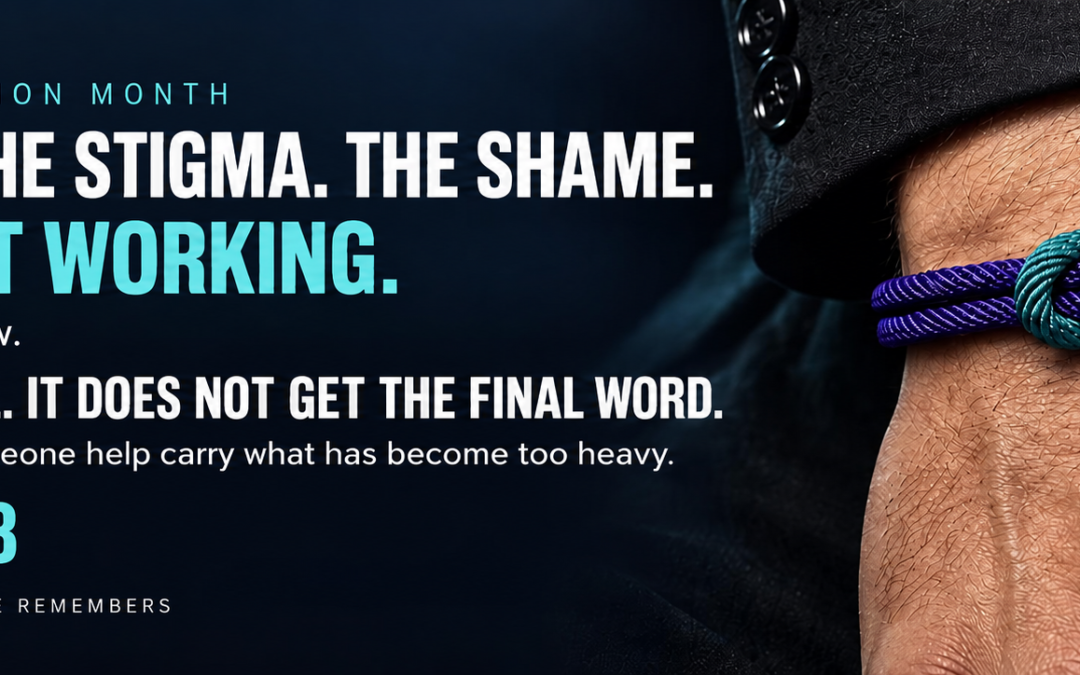

Stand in the Uncomfortable
The hush around suicide is not protecting us—and shame is not healing us
A Suicide Prevention Month reflection for the Church and the people we love
Content note: This article discusses suicide, suicidal thoughts, mental illness, and suicide loss. If you are in immediate danger, call 911. In the United States, call or text 988 or visit 988lifeline.org for free, confidential support, 24 hours a day.
We know how to stand publicly against many kinds of suffering. We walk for cancer. We wear ribbons. We hold fundraisers, tell survivor stories, celebrate remission, and speak the names of those we have lost.
But when the cause of death is suicide, our posture often changes.
Voices lower. Details disappear. Obituaries become vague. Friends hesitate because they do not know what to say. Families sometimes feel that they must protect the reputation of the person they loved—and protect themselves from questions, blame, gossip, or judgment.
Some people have told me that speaking openly about suicide makes them uncomfortable. I hear that. Suicide is uncomfortable. It brings us close to suffering we cannot neatly explain or repair. It raises questions about illness, responsibility, faith, family, and death. Silence can feel safer than the possibility of saying the wrong thing.
I am not interested in shaming people for feeling that shame or discomfort. Shame grows easily where pain has no language. Most of us were never taught how to talk about suicide, respond to an attempt, or accompany a family after a suicide loss. Many people become quiet not because they do not care, but because they care and feel helpless.
But discomfort cannot be the end of our response.
Maybe Suicide Prevention Month is an invitation to stand in the uncomfortable—and then stand up to the stigma.
The hush has not made us safer
Suicide is not a rare problem happening somewhere else. According to the Centers for Disease Control and Prevention, 48,824 people in the United States died by suicide in 2024. During that same year, an estimated 14.3 million adults seriously considered suicide, 4.6 million made a plan, and 2.2 million attempted suicide.
The national suicide rate increased substantially over the longer term, although it has been comparatively stable in recent years. The crisis remains painfully high. CDC data show why we must retain both urgency and accuracy when discussing it.
Silence did not cause every suicide, and one conversation cannot prevent every death. Suicide is complex; it rarely has one cause. Mental health conditions can be part of the story, but so can loss, loneliness, substance use, relationship crises, financial strain, chronic pain, trauma, and other forms of unbearable distress. The World Health Organization specifically identifies this wider range of contributing factors.
Still, silence has consequences.
The World Health Organization warns that stigma around mental health and suicide prevents many people who are considering suicide from seeking help. A systematic review of suicide-bereavement research found that loss survivors experience shame, blame, and avoidance. Stigma was associated with concealing the death, withdrawing socially, losing support, and experiencing greater grief difficulties.
That is the cruel work of stigma: it tells the person in crisis, Hide what you are thinking. It tells the family after an attempt, Do not let anyone know. It tells the grieving, Change the subject. It tells the church, This is too complicated for Sunday morning.
Then everyone suffers in separate rooms.
One common fear is that speaking plainly about suicide might plant the idea in someone’s mind. Research does not support that fear. The National Institute of Mental Health says that asking directly, “Are you thinking about suicide?” does not increase suicidal thoughts or behavior. A caring, nonjudgmental conversation may reduce suicidal thoughts and open a path to help.
The answer, then, is not careless talk. The answer is honest, responsible, compassionate talk—speech that does not sensationalize a death, describe methods, assign a simple cause, or turn a person’s worst moment into the summary of an entire life.
We can tell the truth and still protect dignity. In fact, truth told with love is one way we protect dignity.
Three things we must face
1. We must face the truth: silence is not safety
We need to be able to say the word suicide calmly, directly, and without treating it as a scandal.
This does not mean every family owes the public every detail. Privacy is not shame. People who are grieving have the right to choose what they share, when they share it, and with whom. Breaking stigma should never become another demand placed upon hurting people.
But privacy and secrecy are not the same thing.
Privacy creates a boundary. Shame builds a prison.
Responsible honesty says:
- A person died by suicide; that is how the person died, not the sum of who that person was.
- A suicide attempt is evidence of severe distress, not proof of selfishness, weakness, manipulation, or a lack of love.
- Mental illness is not a character defect, and seeking treatment is not spiritual failure.
- Families affected by suicide deserve the same meals, prayers, cards, presence, patience, and public compassion offered after other devastating losses.
We should also resist the temptation to explain a suicide with one sentence. Human beings are not equations. A diagnosis, breakup, job loss, or difficult day may be part of a story, but no single detail gives us complete access to another person’s pain.
Truth requires humility as much as courage.
2. We must face the stigma: suffering is not shame
Why do people hush?
Sometimes we are afraid of judgment. Sometimes we fear that a family will be blamed. Sometimes old religious messages have left people believing that suicide is a subject too dark, sinful, or hopeless to bring into the light.
Sometimes we imagine that strong Christians should be able to pray away depression, silence intrusive thoughts, or overcome trauma without medical or psychological care. Sometimes we simply cannot bear the feeling that we might have missed something.
So we search for someone to blame—the person, the family, the church, the clinician, or even ourselves—because blame can feel easier than helplessness.
But shame is a poor grief counselor, and blame is a poor prevention plan.
We can acknowledge moral and spiritual questions without reducing a suffering person to a verdict. We can take suicidal danger seriously without treating the person as dangerous to our reputation. We can honor personal responsibility while recognizing that severe mental illness and acute crisis can distort judgment, narrow a person’s sense of available options, and make temporary pain feel permanent.
The Church should be one of the safest places to say:
“I am not okay.”
“I am having thoughts of suicide.”
“Someone I love died by suicide.”
That safety requires more than kind intentions. It requires pastors and ministry leaders who know how to ask direct questions, recognize warning signs, refer people to qualified care, respond to immediate danger, and continue walking with families after the funeral.
Prayer and professional care are not enemies. Medication, counseling, crisis intervention, friendship, pastoral care, and prayer can stand in the same circle.
We do not tell someone experiencing chest pain to choose between prayer and a cardiologist. We should not force that false choice upon a person whose mind is in crisis.
3. We must face our responsibility: compassion must become action
Standing against stigma is not merely posting a ribbon in September. It means learning what to do when the conversation becomes real.
The 988 Suicide & Crisis Lifeline and the National Institute of Mental Health offer a practical pattern:
- Ask directly.
- Be present.
- Help keep the person safe.
- Connect the person with support.
- Follow up.
Listen without lecturing. Do not debate whether the person’s feelings are right or wrong. Do not promise to keep a suicide plan secret. If danger is immediate, act. These practices are explained further in the 988 Lifeline’s guidance for helping someone else.
And after a suicide loss, do not disappear because you lack perfect words.
Say, “I am so sorry.”
Say, “I am here.”
Say the person’s name if the family welcomes it.
Remember that grief continues long after the casseroles stop arriving. Check in after the funeral, after the first month, on holidays, and on the ordinary Tuesday when everyone else has gone back to normal.
Communities and churches can act before a crisis, too. Put 988 and local counseling resources where people can find them. Train staff and volunteers. Invite qualified mental health professionals into the conversation. Create a culture in which testimony includes treatment, recovery, relapse, lament, and hope—not only tidy victories.
Awareness matters most when it becomes availability.
What does a Christian do with suicide loss?
A Christian begins where Scripture begins: with truth about a broken world, compassion for suffering people, and hope rooted in the character of God.
First, we lament.
Jesus did not hurry past grief. At Lazarus’s tomb, “Jesus wept” (John 11:35). The Psalms give faithful people language for anguish, confusion, fear, and even the feeling of abandonment.
Grief is not unbelief. Questions are not betrayal. Tears are not a failure to trust God.
Second, we draw near.
“The Lord is near to the brokenhearted and saves the crushed in spirit” (Psalm 34:18, ESV).
If God moves toward the brokenhearted, His people should not move away. Romans 12:15 tells us to weep with those who weep, and Galatians 6:2 calls us to bear one another’s burdens. Presence is deeply Christian, even when explanations are impossible.
Third, we leave final judgment with God.
We do not know everything that happened within another person’s mind, body, history, illness, or final moments. God alone sees the whole person and judges with perfect knowledge, justice, and mercy.
Our assignment is not to turn a graveside into a courtroom or make confident declarations Scripture does not authorize us to make. Our assignment is to love the grieving, care for the vulnerable, speak truth without cruelty, and point people toward help and hope.
Finally, we refuse to reduce a whole life to the way it ended.
A person who died by suicide was a bearer of God’s image before that death and remains worthy of being remembered with honesty and love. The final chapter matters, but it does not erase every chapter that came before it.
The Church does not honor God by pretending mental illness is not real. We honor God when we meet suffering with truth, wisdom, mercy, and courageous care.
Let us stand up
We have lived too long with a kind of unwritten instruction around suicide:
Sit down. Lower your voice. Do not make anyone uncomfortable.
But prevention asks us to stand up.
Stand up to the idea that a suicidal person should suffer privately.
Stand up to the belief that a family should carry shame for a loved one’s death.
Stand up to careless theology that adds condemnation to trauma.
Stand up to our own fear of asking a direct question.
Stand in the uncomfortable long enough to listen. Stand beside the grieving long enough that they no longer feel abandoned. Stand with the person in crisis long enough to connect them with help.
We do not break the hush by shouting. We break it by speaking clearly, listening humbly, and refusing to let shame have the final word.
Suicide Prevention Month is not a request to become comfortable with suicide. We never should.
It is a call to become courageous enough to talk about it—safely, honestly, and with love.
If you or someone you know needs help
In the United States, call or text 988 or visit 988lifeline.org to connect with the 988 Suicide & Crisis Lifeline. It is available 24 hours a day and provides free, confidential support. If someone is in immediate danger, call 911.
Ask plainly: “Are you thinking about suicide?”
Stay with the person. Listen without judgment. Help reduce access to anything they could use to harm themselves. Connect them with 988, a qualified mental health professional, a trusted loved one, or emergency care. Follow up afterward.
You do not need perfect words to help save a life.
You need the courage to care out loud.
This article is for education and encouragement and is not a substitute for professional mental health care or emergency services.

Let Us Stand Up
We have lived too long with a kind of unwritten instruction around suicide:
Sit down. Lower your voice. Do not make anyone uncomfortable.
But prevention asks us to stand up.

Article submitted.